
WireGuard Proxy Protocol
Introduction
WireGuard is a modern, lightweight Virtual Private Network (VPN) protocol designed to establish secure, encrypted network connections between devices over untrusted networks, such as the public internet.
It provides a high-performance alternative to traditional VPN technologies by using modern cryptographic algorithms, a streamlined connection mechanism, and a relatively small implementation.
WireGuard operates at Layer 3 (the network layer) of the OSI model and encapsulates IP packets inside encrypted UDP packets. It allows two or more network peers to communicate securely, regardless of their physical location or underlying network infrastructure. It can also be used as the foundation of a proxy VPN service. In this configuration, a client connects to a remote WireGuard server and routes some or all of its internet traffic through that server. The server then forwards the traffic to its intended destination.
An important distinction is that WireGuard is not itself an application-layer proxy protocol. It creates an encrypted network tunnel that can provide proxy-like traffic forwarding at the IP routing level.
Core architecture
WireGuard uses a peer-to-peer architecture in which each participating device is identified by a cryptographic public key.
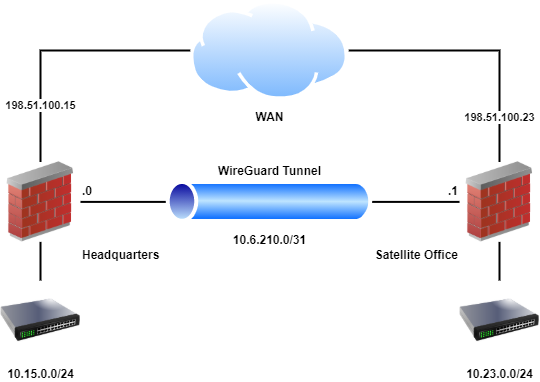
A typical proxy VPN deployment consists of two primary components:
- WireGuard Client: The device initiating the VPN connection. It establishes an encrypted tunnel and sends network traffic through it.
- WireGuard Server: The remote VPN endpoint that authenticates the client, decrypts incoming packets, and forwards permitted traffic toward its destination.
Additional peers can be configured to support multiple clients, site-to-site connections, or distributed network architectures.
Cryptographic foundation specifications
WireGuard uses a fixed collection of modern cryptographic primitives rather than supporting a large collection of configurable encryption suites.
Algorithm | Purpose |
|---|---|
Curve25519 | Elliptic-curve Diffie-Hellman key exchange |
ChaCha20 | Symmetric encryption |
Poly1305 | Message authentication |
HKDF | Cryptographic key derivation |
BLAKE2s | Cryptographic hashing |
SipHash24 | Hash-table key protection |
WireGuard connection establishment
WireGuard connections are commonly blocked on public networks, such as work or school. This can disrupt applications and services which rely on this proxy protocol technology.
WireGuard uses the Noise_IK handshake pattern to establish secure communication between peers.
The handshake is designed to authenticate the participating devices and derive session encryption keys efficiently.
Before establishing a connection, both peers must have the appropriate cryptographic and network configuration.
The client needs:
- Its own private key
- The server's public key
- The server's network endpoint
- Its assigned VPN IP address
- The permitted destination networks
- An optional pre-shared key
The server needs the corresponding client public key and the permitted VPN addresses associated with that peer.
About this article
- Written by Gary Phatt, a TheOpenRoad Support employee.
- Still need help? Please write to us in the comment section below or contact TheOpenRoad support.

Please rate your experience with this article today:
When you select a number, 1 being the lowest and 9 being the highest; the page will refresh and your feedback will be submitted to TheOpenRoad.